



When the Giraffe brand compass box was launched in the market, it became an instant craze among students. Within a week, everyone in Avinash’s class had one – except him. One evening, when he had accompanied Godavari to the market, he saw the compass box at a stationery shop. He told her about it, and she hesitantly inquired about its price. The shopkeeper promptly presented one of the compass boxes at the counter and mentioned its price.
“Oh, we’ll buy it later,” she said, handing it back. Avinash knew the reason behind her answer and kept quiet.
At school the next day, Panvelkar announced that he would conduct a special coaching class after school hours to prepare deserving students for the elementary and intermediate grade drawing examinations conducted by the state government. A few interested students raised their hands. Avinash wanted to take the class as well, but he did not raise his hand – signing up for the special class meant paying an extra fee.
He avoided looking at Panvelkar and kept doodling in his notebook with a pencil stub, desperately wishing for some magic that would make him disappear from his teacher’s sight.
“What about you?” he heard Panvelkar ask, but he did not look up. There was silence in the class.
“Avinash, I’m asking you,” Panvelkar said.
Prasad nudged him, and Avinash’s heart missed a beat. He stood up and looked around. The entire class was agog over the conversation that was unfolding.
“Not interested?” Panvelkar asked. Avinash avoided making eye contact with his teacher and didn’t say anything. “You will pick up very fast,” Panvelkar said. “I want students like you.”
“I’ll ask my parents,” Avinash mumbled, hanging his head.
Panvelkar looked at him, bewildered. “All right,” he said. “Let me know.”
That evening, when Avinash brought up the topic at home, Godavari got irritated. “Where will the money come from? You think it grows on trees?” she shouted.
Without saying another word, he went and sat on the threshold of the house, looking at the fascinating spectacle of the city spread out below, vibrant as ever.
A few days later, while walking in the school corridor during recess, Avinash spotted Panvelkar coming down the corridor from the opposite direction. To avoid him, he started walking behind some students. Keeping his head down as he walked, Avinash hoped that Panvelkar had not seen him, but in vain.
“Avinash,” he heard Panvelkar’s voice and stopped. “Have you told your parents about the drawing class?”
“Err … yes, sir,” he said. “But they said there was no need to join it.”
“Why? What’s the problem?” Panvelkar asked.
“They are not interested.”
Panvelkar looked at him for a while. “Are you interested?”
“I am, but …”
“But?”
“They say we can’t afford it.”
“Oh. Ask your mother or father to see me, and you start coming to the extra class from today,” Panvelkar said.
Avinash nodded. He wasn’t sure how his parents would react, but he hoped that Panvelkar would convince them to let him join the class.
The temptation of playing with colours was irresistible. So, that day, he stayed back after classes and went to the art classroom.
Without a word, Panvelkar opened a cupboard and provided him with pencils, colours, brushes and paper. Then he started instructing all the students in the class, and Avinash soon got lost in his favourite subject.
Reaching home late in the evening, he found Godavari busy cooking and his father away on duty. She greeted him with a glare. “Why are you so late?” she demanded.
When he told her about what had happened, she calmed down and after a long pause said, “Your education is becoming more and more expensive by the day.”
The next day, when Avinash and the other students were in the art class, Dagadoo appeared at the door of the classroom. He was dressed in his watchman’s uniform. Avinash went to Panvelkar and told him that his father had come to meet him. Panvelkar asked him to continue with his work and went to talk to Dagadoo. The students in the class looked at one another, their eyebrows raised in curiosity.
“That’s my father,” Avinash said.
“Your father is a watchman?” Atharva asked.
“Yes,” Avinash replied. Atharva shrugged, while some of the more amused students giggled.
After a brief whispered conversation, Dagadoo folded his hands, smiled and left.
“Your father has agreed to let you attend this class,” Panvelkar told Avinash when he came back in. “You can continue now.”
When Avinash reached home that evening, Dagadoo told him that Panvelkar had waived the fee for him. It came as a beautiful surprise, and from that day onwards, Avinash started finding the school less repulsive. He would wait eagerly for the regular classes to conclude so that he could rush to the art classroom.
A month later, Panvelkar announced that an inter-school painting competition had been organised. He selected Avinash and three others, including Atharva, from the entire school to participate in it. When Avinash hesitated, Panvelkar called him closer and whispered that he would also provide the necessary drawing material for the competition, which was in two weeks’ time. The competition venue was the spacious hall of another school nearby.
On the day of the competition, as he was nearing the entrance, Avinash saw Atharva approaching. They smiled and wished each other luck as they walked in together.
“I had gone to a temple today to offer special prayers for my success,” Atharva said, pointing at the tilak, the holy mark, on his forehead. “You didn’t go?”
Avinash shook his head. “We follow Buddhism, and there is no god in Buddhism,” he said as Atharva cast him a scornful glance.
Suddenly, a cat crossed their path, startling Atharva, who halted and retraced a few paces, muttering something inaudibly.
“What happened?” Avinash asked.
“Didn’t you see the cat crossing our path?”
“So what?”
“That’s a bad omen! I don’t think either of us will win a prize today.”
Avinash scoffed. “I don’t believe in superstitions,” he said.
“You will, when we don’t win any prizes,” said Atharva confidently.
A little later, the competition began once the topic was announced, and the contestants became busy with their artwork. After the competition was over, Atharva was anxious and sweating profusely. “Do you think we’ll win the prize?” he asked Avinash as they came out of the hall.
“I don’t know – there were some students better than me and some worse,” Avinash said. “Participating in the event was a big thing for me, and that’s what I enjoyed.”
Atharva sighed. “I hope my prayers are answered,” he said. “Aren’t you afraid that your parents will shout at you if you don’t win a prize?”
“No.”
“Really? How come?”
Avinash smiled. “I’m the first person in my family to go to school and learn. Even if I lose, my parents won’t mind, and I’ll try to do better in the future. If I win, it’s simply a bonus.”
“You’re so lucky! I have to get at least a consolation prize, or my parents will yell at me,” he said.
“Oh! Really?”
Atharva nodded his head. “They want me to top in everything,” he said. “They don’t understand that I can’t be good at everything.”
“Don’t worry, they’ll understand,” Avinash said. “They are educated.”
Atharva didn’t reply and went home with a gloomy face.
At home, Avinash found Godavari cutting vegetables. Dagadoo and two men from the neighbourhood were drafting a letter to the civic authorities about some issues in the locality.
“How was the competition?” Godavari asked.
“I enjoyed it.”
“Who won?”
“I don’t know,” Avinash said. “The result will be announced in a few days.”
She folded her hands, looked up at the roof and said, “He will bless you.”
Dagadoo looked up and then stared at Godavari. “There is nobody up there,” he said. “Nobody is going to descend from the sky and perform miracles. It’s all about sincerity, hard work and skill.” Then he turned to Avinash. “Don’t be disheartened if you don’t win a prize,” he said. “At least you got an opportunity to show your talent. Many talented people don’t even get that.”
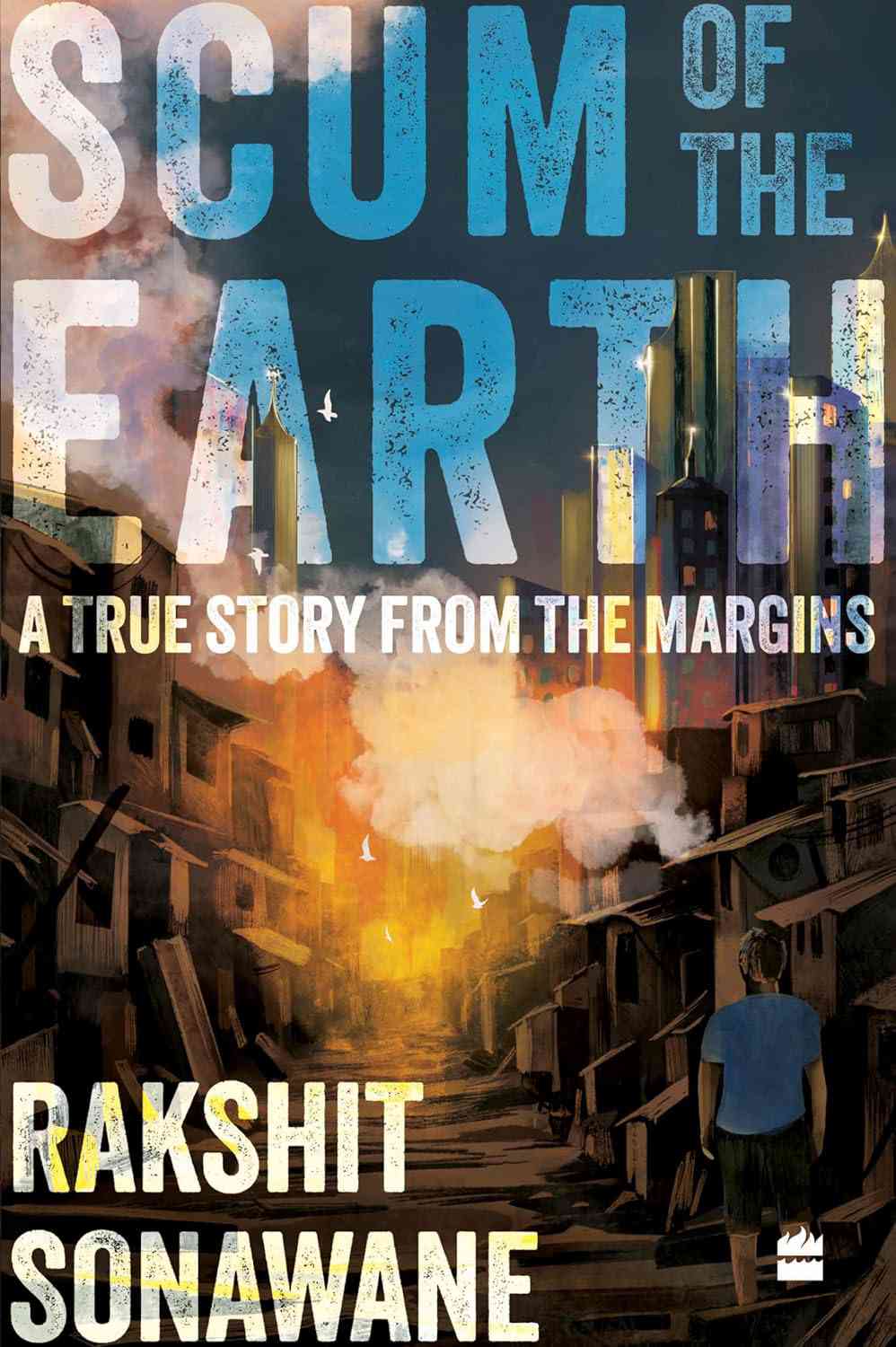
Excerpted with permission from Scum of the Earth: A True Story from the Margins, Rakshit Sonawane, HarperCollins India.
